Dad Recommends · Home & Garage · Honest Review
Whynter BR-130SB Review: The Beer Fridge Every South Florida Dad Deserves
I bought this fridge in April 2022 — back then I had a 1-year-old, a very strong opinion about cold beer and a wife with a stronger opinion than me about it. Four years later, the fridge is still here, still running, but now I have a 5-year-old, a pregnant wife, way too little free time... and even less time for beers — that explains the empty shelves. The fridge is still delivering that first sip the way a first sip should feel. Here's everything you need to know, including the one temperature setting mistake you absolutely want to avoid.
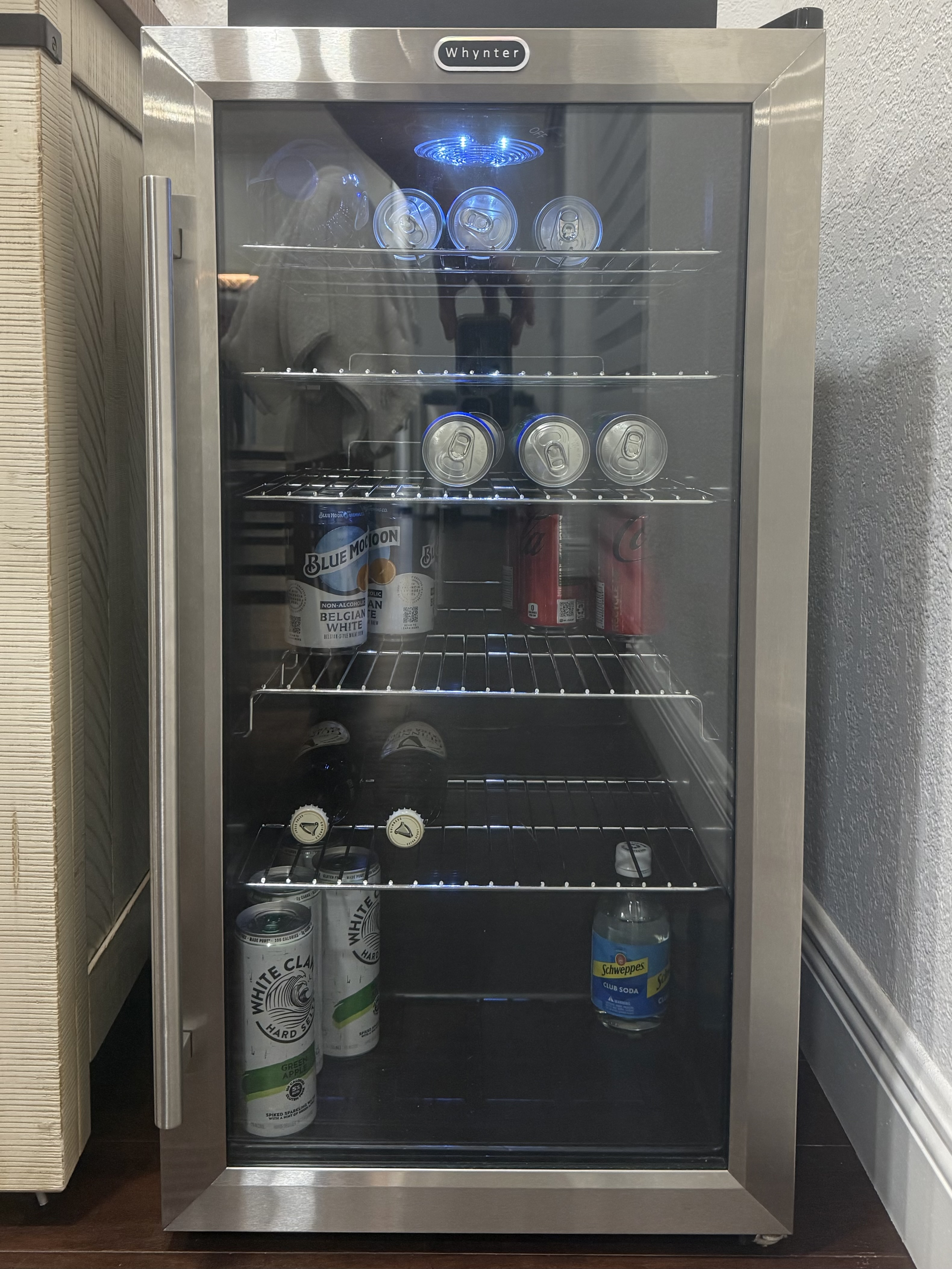
I want to be clear about something upfront: I didn't need a dedicated beer fridge. There was nothing wrong with the kitchen fridge. I wanted one. And after years of telling myself it was a luxury I'd get around to, I finally just bought it. Best decision I've made for myself in this house, easily.
The model I chose is the Whynter BR-130SB — a 127-can stainless steel beverage refrigerator with a double-pane glass door, internal fan, and a temperature range that goes cold enough to make your beer actually cold, not just "fridge cold." There's a difference. If you live in South Florida, you know exactly what I mean.
Why a Dedicated Beer Fridge and Not Just the Kitchen Fridge
The kitchen fridge is busy. It's running at 37–38°F to keep food safe, people are opening it constantly, and it's full of leftovers, kid food, and things that have been in there way too long. None of that is ideal for beer.
A dedicated beverage fridge lets you dial in the exact temperature you want for drinks — nothing else. You're not balancing it against a gallon of milk. It also means the kitchen fridge is freed up from being opened every time someone wants something cold to drink, which matters more than you think in a house with kids.
In South Florida specifically, there's another reason: ambient temperature. Our garage and utility spaces run hot. You want a fridge that can hold its temperature even when the room around it is 80+ degrees. The Whynter handles this without issue — it's designed for freestanding use, with front-facing ventilation so it doesn't need air clearance behind it.
What I Actually Like About This Fridge
The glass door is the main reason I chose this model. It sounds superficial, but it matters. You can see what's in it without opening it. That's energy efficient, sure, but more importantly, it looks good. This fridge sits in a visible spot in my home and I don't want something that looks like a dorm appliance.
The double-pane glass keeps condensation off the outside of the door, which is critical in Florida humidity. Single-pane glass doors sweat. This one doesn't.
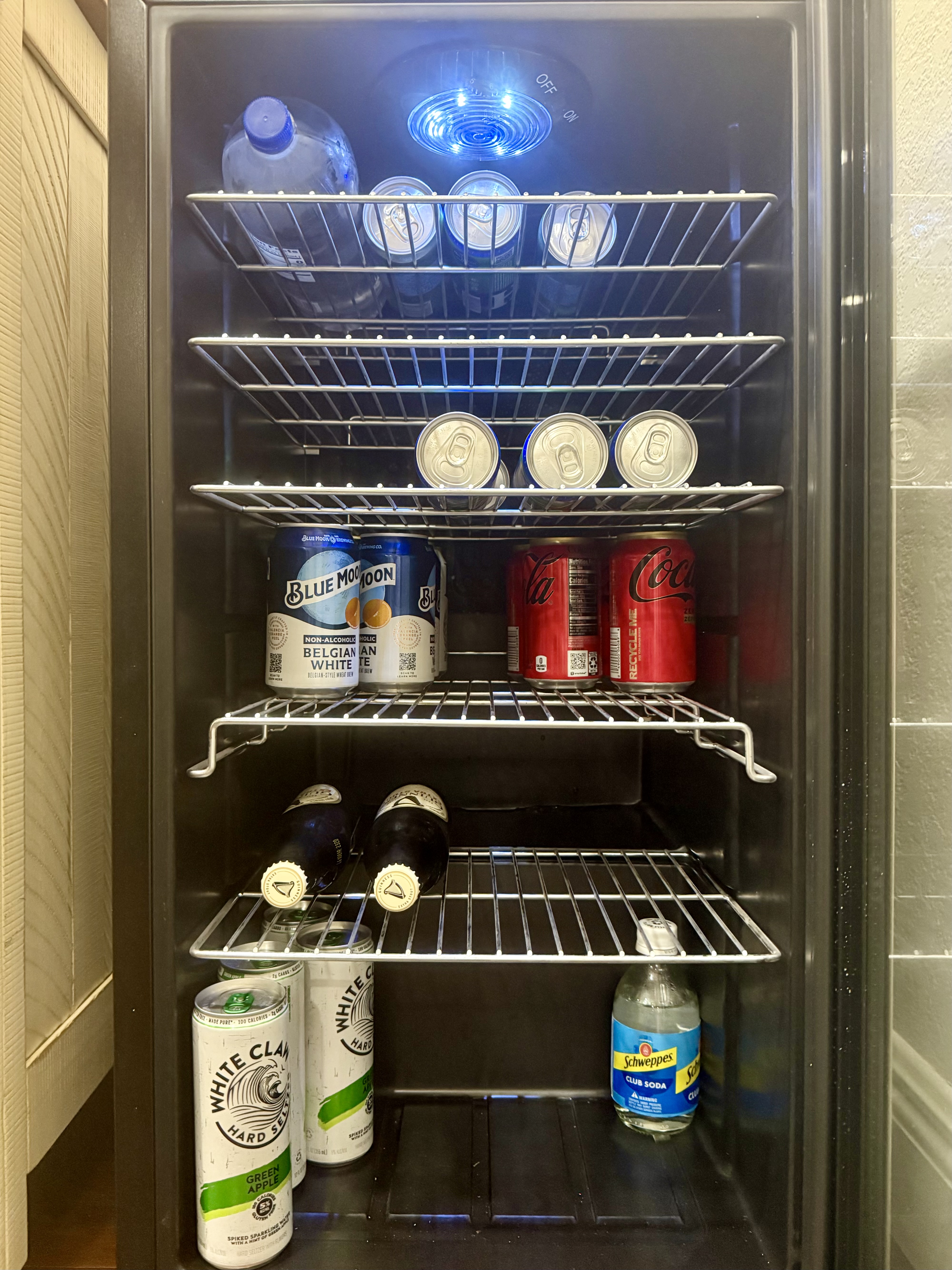
The five slide-out wire shelves accommodate standard 12 oz cans, bottles, and 16 oz tall boys without issue. The shelves are sturdy — no wobble, no sag. And the soft LED interior lighting is just enough to see everything clearly without looking like a gas station cooler.
Noise level is under 44 dBA according to the spec sheet. In practice, I forget it's running. I can hear the compressor cycle on and off occasionally if the house is very quiet, but it's barely noticeable. Nothing like an old refrigerator hum.
Whynter BR-130SB — Quick Specs
- 33"H × 17"W × 18.5"D (20.5"D with handle)
- 57 lbs net
- 127 standard 12 oz cans
- Temperature range: high 30°F – mid 60°F
- 85W input power · 0.96 kWh/24h
- Under 44 dBA
- Double-pane tempered glass door
- Front-vented — no rear clearance needed
The One Temperature Setting You Need to Get Right
This is the most important part of this whole article. The Whynter BR-130SB has a dial thermostat that runs from 1 to 7 (or similar scale depending on your unit). The temptation — especially when you first get it and want your beer ice cold — is to crank it to max. Don't do it.
At maximum setting, this fridge will get cold enough to ice over the coils. You'll start finding ice forming inside, the drain tube can get blocked, and you may end up with standing water at the bottom of the unit. It's not a malfunction — you're just pushing it beyond what it needs to be.
Here's the approach that's worked perfectly for me: start at setting 5. Give it 24 hours. Check the temperature and how cold the beers are. If you want it colder, move to 6. Let it settle again. In my unit, I found the sweet spot just above 6 — close to 7 but not all the way. That hits the 34–36°F range that gives you that genuinely cold first sip without any ice issues.
Four Years Later — Honest Take
The fridge has performed exactly as it did on day one. No issues with the compressor, no temperature drift, no weird noises. The shelves have held up. The glass door seal is still tight. The LED light still works.
The only maintenance I've done is the occasional wipe-down of the interior and keeping the condenser area dust-free. That's it. Four years of South Florida heat and humidity and this thing just keeps running.
I'll be honest about the pictures: when I bought it, this fridge was full. I had recently moved into a bigger house, we were setting up the garage, and I had ambitions. Then a second kid arrived. Free time got shorter. The fridge is less full now than it used to be. But when I do open it — when I actually have a free hour and a cold beer waiting — that first sip is worth every cent I paid for it.
This is a freestanding unit, meaning it needs front clearance for ventilation but doesn't need to be built into cabinetry. It fits neatly in a garage corner, a utility room, or any spot with an outlet. Footprint is small — only 17 inches wide.

Whynter BR-130SB — 127-Can Beverage Refrigerator
Stainless steel exterior, double-pane tempered glass door, internal circulation fan, and soft LED lighting. 127-can capacity in a 17-inch-wide footprint. Front-vented — no rear clearance needed. Temperature range from the high 30s to mid 60s Fahrenheit.
I've owned this exact unit since April 2022. It's handled four South Florida summers without complaint. If you want one recommendation from me on a beer fridge, this is it. Follow the temperature tip above and you'll never have an issue.
View on AmazonWhat It Won't Do
It's not a garage-rated fridge. Garage-rated fridges are specifically engineered to operate in very wide ambient temperature swings — from near-freezing winter nights to scorching summer days. If you're putting this in an unconditioned South Florida garage where it can hit 100°F in summer, you're pushing the limits of what it's designed for.
My unit lives in an air-conditioned utility room. If yours will live in a hot garage, make sure there's some airflow around it, or consider whether a garage-rated model is the right choice for that specific location. For inside the house — a utility room, a game room, a home bar — this fridge is exactly right.
It also doesn't have a lock. If you have kids in the house, that's worth knowing. You can find aftermarket cabinet locks that work with doors like this, but there's no built-in mechanism.
The Bottom Line
If you're a South Florida dad who wants a dedicated beer fridge that looks clean, holds a lot, runs quietly, and doesn't require any maintenance beyond keeping it clean — the Whynter BR-130SB is the right call. I've had mine four years and I'd buy it again without hesitation.
Start at temperature setting 5. Work up to your sweet spot. Don't max it out. You'll be fine.
The fridge might not always be full. That's okay. When it is, and when you finally get that hour to yourself, it's worth it.