Home · HVAC · Dad Recommends
My Brand-New Lennox Was Leaking. Two Techs Couldn't Find It. A $21 Detector Did.
I got home from a trip abroad at 7am on a Friday before Memorial Day weekend to find my house at 85°F. The Lennox system was 19 months old, under warranty, and leaking refrigerant somewhere nobody would bother to look. Here's how I found it myself — and what it ended up costing.
There's a specific kind of frustration that hits you when you land after an international flight, step through your front door at 7 in the morning, and realize your house is 85 degrees. You've been gone for two weeks. You're running on whatever passes for sleep on a redeye. Your AC should be working fine — you had a whole new Lennox system installed nineteen months ago. And yet.
That's where this story starts. And it ends with a $21 Amazon gadget proving two grown professionals wrong. But let's go in order.
Friday Afternoon. 5pm. Two Hours Late. Pouring Rain.
I called the company that installed the system first thing. Explained the situation. They scheduled a visit for 3pm that same Friday.
The technician showed up two hours late — right around 5pm, right as it started pouring. I'd already paid $155 just for that visit. He looked at the system — a Lennox CBA38MV-048-230-6-02 air handler paired with an EL18XCVS048-230A01 condenser, installed nineteen months earlier and still fully under warranty. He couldn't detect any leak from the air handler. His conclusion: it was probably the external unit. His problem: it was pouring outside, so he wasn't able to work out there. His recommendation: call us back and schedule another visit.
"You're kidding me." I was not, in fact, kidding him. But he was already headed for the door.
I told him to at least take a look before leaving. He did — briefly — then confirmed his recommendation and left. I called the company immediately. They were closed. It was Friday evening going into Memorial Day weekend. The earliest anyone was getting back to me was Tuesday.
Enter the Savior.
Same Friday evening, I found a local independent technician — the kind of guy who picks up the phone himself and shows up when you need him. A Colombian guy running his own small shop. I'm going to call him the Savior, because that's what he was.
The Savior checked the system carefully. Couldn't find the leak either — it was that well hidden. His assessment was honest: he could recharge the system so I'd have cool air through the long weekend, but the leak was still there, and since the unit was under warranty, I needed to make the installer come back and fix it. For free.
I paid him $727 for the recharge and his time. Fair. I'm an engineer. I hate not knowing where problems are coming from. I was uncomfortable with the situation the same way I'm uncomfortable with any unresolved variable. So I did what engineers do when they can't get a straight answer from the people who are supposed to have one.
I went on Amazon.
The $21 Device That Changed Everything
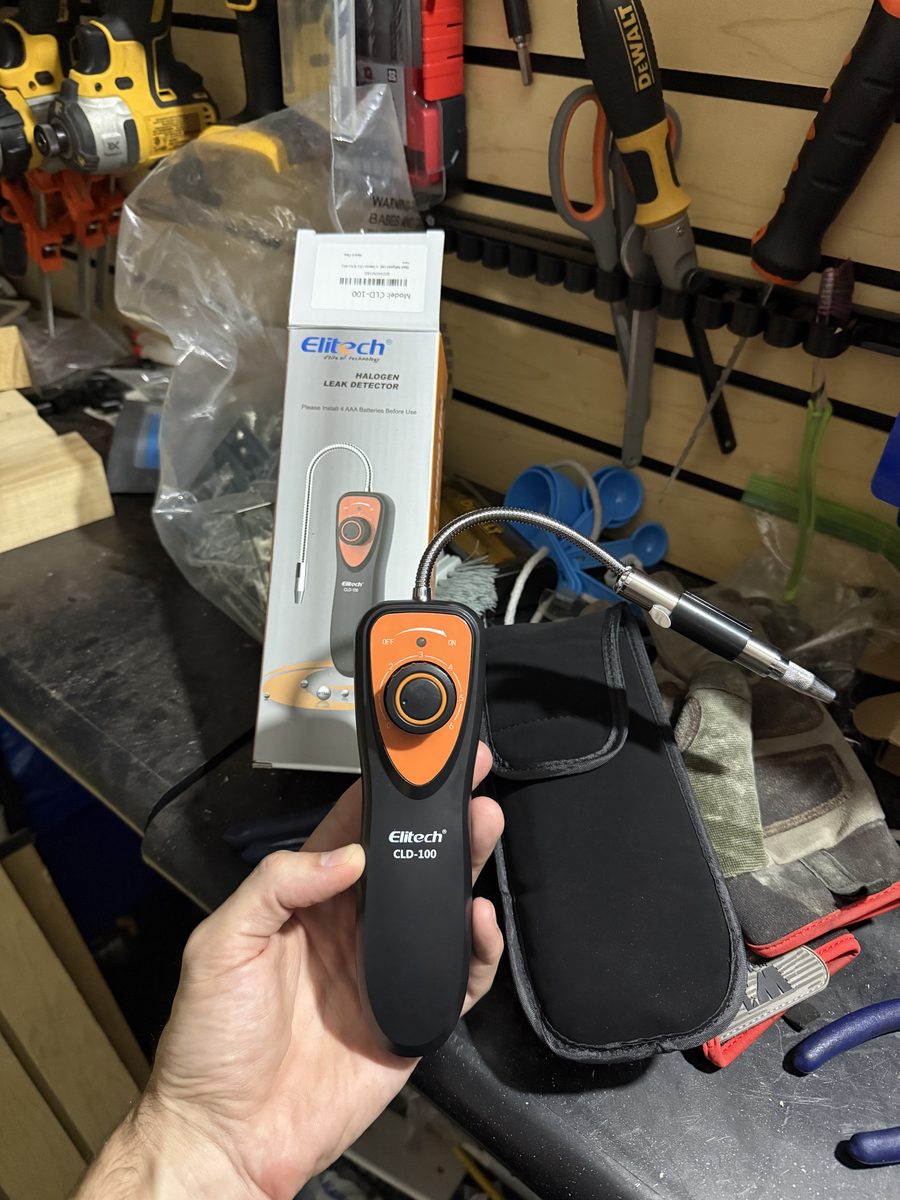
Elitech CLD-100 Refrigerant Leak Detector
Detects R-410A, R-22, R-134a and all common HVAC refrigerants. Audible alarm speeds up as you approach the source. 8" flexible probe. Adjustable sensitivity. No license required to own one.
I paid $21 — next-day delivery.
View on AmazonIt came to my front door Saturday — next-day delivery, exactly as promised. Memorial Day weekend, and I had a tool. Now I just needed to wait until the house cooled down enough to think straight.
DIY Leak Hunt: Systematic, Outdoor First
I did my homework. Refrigerant leaks most commonly occur at the condenser coils, the service valves, the line set connections, or the evaporator coil inside the air handler. I decided to be methodical about it.
I went outside to the outdoor condenser unit first. Turned on the detector. Started moving it slowly around the refrigerant lines, the service valves, the coils. The device stayed quiet — a steady, patient silence that said: nothing here, keep moving.
Back inside to the air handler.
I opened the unit and moved the detector toward the evaporator coil. That's when it changed. Beep. Beep. Beep-beep-beep-beep. The faster the beeping, the closer the source. I had found it. Or at least, I'd found exactly where to look.
Tuesday. Same Tech. Still Laughing.
Tuesday. Long weekend over. I called the company, explained that I had located the leak myself, and asked them to send someone to repair it. Under warranty. No charge for parts.
They sent the same tech from Friday.
He laughed when I showed him the device. Not a polite chuckle — an actual dismissive laugh. He told me that even if you opened a bottle of refrigerant right next to it, that thing wouldn't detect anything.
So we went to his van. He opened a bottle of refrigerant. I held the detector near it.
Beep-beep-beep-beep-beep.
The tech looked at the device. Then at me. Then back at the device. "Okay," he said slowly. "It's detecting." Then, almost immediately: "But it's still not going to find you an actual leak. You're going to need to pay about a thousand dollars to cut the lines and do a full inspection."
The Savior, Again. UV Light. Five Minutes.
I called the Savior back. Explained the whole situation — the warranty, the tech's attitude, the device readings, the exact spot where it was beeping. He came right over. No hesitation.
I showed him where the detector had gone off. He grabbed his UV light and went straight to the evaporator coil in the air handler — exactly where the $21 device had pointed. Five minutes later, he had it. A leak, right there, plain as day under the UV lamp.
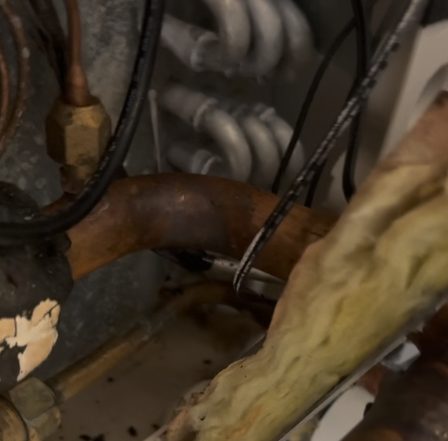
His read on the situation: "This is under warranty. You shouldn't pay for parts. Call them, tell them where the leak is, and make them replace the unit."
The Resolution (And the Bill)
I called the company one more time. I specifically asked that they not send the same technician, and I explained why. They sent someone different.
The new tech verified the leak. Certified it was exactly where I said it was. The Lennox CBA38MV-048-230-6-02 air handler — installed only 19 months earlier — had to be replaced entirely. Under warranty, that meant no charge for the equipment.
Labor: $1,613.
Add the $155 first-visit fee and the Savior's $727 recharge, and you're at $2,495 out of pocket on a system that was still under warranty. That's not nothing. But compare that to what the Friday tech was proposing: a thousand-dollar "inspection" to locate something a $21 device had already found — on top of whatever labor they'd charge for the actual repair.
What I Learned (That Dad Would Have Told You)
Your new HVAC warranty covers parts, not labor. Read it. Most residential systems — including Lennox — come with 5–10 year parts warranties, but labor is on you. Every visit, every repair, every replacement: labor. The $1,613 I paid was entirely labor to install the replacement air handler. Budget for it, because even a warranty claim will cost you.
The company that installed it is not always your best option for the repair. The Savior showed up the same Friday evening as the warranty tech — who left two hours late having done nothing — and he found the leak location within five minutes using a UV light and the coordinates my $21 device gave him. That's the difference between someone who's invested in solving your problem and someone running out the clock.
A $21 detector is leverage. Not because you're going to fix the leak yourself — refrigerant work requires EPA certification and you should never touch it without a license. But because it gives you information before you're in a room with a technician. When you can walk a tech directly to the source and say "it's beeping here," the conversation changes. They can't dismiss what they can't disprove.
Know your rights with warranty work in Florida. If a system is under manufacturer's warranty, the installing company is obligated to honor it. If they're stalling, dismissing your concerns, or trying to charge you for work that should be covered — push back, document everything, and if needed, escalate directly to the manufacturer.
Get It Before You Need It
In South Florida, AC isn't optional and HVAC problems don't wait for convenient timing. If your system ever seems off, this is how you walk into the conversation informed — before spending $155 on a visit that goes nowhere.
Around $21 on Amazon.
View on AmazonMy house is cool. The unit is new. The Savior is still my first call for anything HVAC-related in Plantation. And I have a refrigerant detector sitting in my garage, ready for next time.
You're welcome. Now go check your thermostat.
This article contains affiliate links. If you purchase through them, we may earn a small commission at no extra cost to you. We only recommend products we've actually used.